

At Smartphone Free Childhood South Africa, we talk a lot about delaying the digital door for our children. But there’s a quiet truth we need to face as parents: our children don’t just listen to what we say. They watch what we do. And they are always watching.
Role modelling isn’t about being a perfect, tech-free parent. It’s about showing our children that humans, not algorithms, are the masters of our time. If we are concerned about healthy child development, and want them to reap the benefits of a “slow-tech, low-tech” childhood, we have to show them what a mindful adult relationship with technology actually looks like.
Parenting against the pull
When parents are on screens around their children, researchers call it “absent presence” or “technoference.” We’re physically there but mentally gone. And the cost is real:
Connection breaks down. Healthy development relies on “serve and return” interactions. A child points at a bird, and the parent responds with eye contact or a comment. When a phone is in the way, those serves go unreturned. Over time, children stop trying.
Emotional security weakens. Children look to our faces to understand how to feel about the world. If our face is neutral and lit by a screen, they lose their emotional compass. They start to wonder if they matter enough to compete with the device.
Micro-moments disappear. A child’s look of pride after stacking blocks. A funny expression. A flash of wonder. These moments are the glue of a relationship, and once missed, they’re gone.
Empathy goes untaught. We teach empathy by showing it. When a child falls and we’re too absorbed in a screen to respond, they miss a lesson in how to care for others.
Spontaneous connection fades. Some of the best parenting happens in the in-between moments: waiting in line, sitting in traffic, lounging on a Sunday afternoon. Without screens, boredom turns into deep conversations and silly games. With screens, we trade intimacy for mindless scrolling.
mindless scrolling.
The power of friction
Our phones are designed to be frictionless. FaceID, infinite scroll, instant notifications. All engineered to pull us in and keep us there. To be more present, we need to add friction back: small speed bumps that force our brains to ask, “Do I actually need to be doing this right now?”
Here’s a few practical ideas:
Park your phone. Create a landing spot (a basket, a drawer) near the front door. When you walk in, the phone stays there. If it rings, you’ll hear it. Everything else can wait.
Make it ugly. Switch your display to greyscale. Without the bright, dopamine-triggering colours, the screen becomes far less appealing.
Ditch the shortcuts. Disable FaceID or TouchID. Typing in a long passcode every time creates a pause where you can decide to put the phone back down.
One-task at a time. No second-screening during a movie with the kids. No phones at the dinner table or in bed.
Intentional innovation: the Swiitch tag
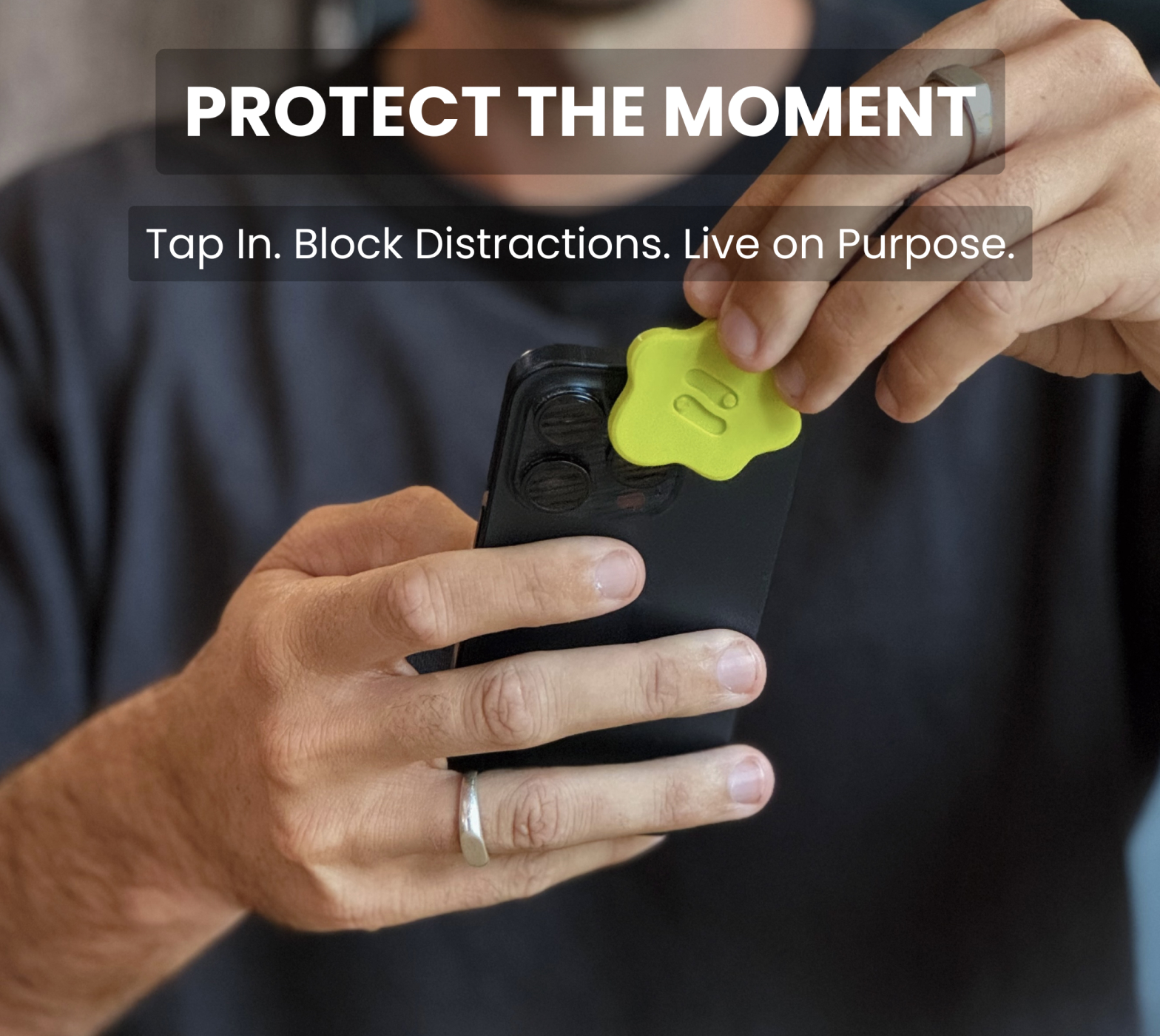
While internal willpower is great, sometimes we need a physical ally. One of the most innovative tools we’ve seen recently is the Swiitch tag.
This clever piece of tech works by adding “intentional friction” to your routine. By pairing a physical tag with the Swiitch app, you can lock your distracting apps with a simple tap.
To get back in, you have to physically tap the tag again. It moves the switch for your digital life out of the screen and into the physical world, giving you a tangible moment to choose presence over the ping.
We think it’s a brilliant way to “Swiitch off” the noise and “Swiitch on” family time.
As a SFC-SA member, you get a 10% discount on your Swiitch Tag at checkout. Please use code SFC-SA10 when ordering. It gives you priority support and helps us continue protecting childhoods.
Let’s build a movement of presence
This isn’t about being anti-tech. It’s about being pro-childhood. By creating friction for ourselves, we pave a smoother path for our children to navigate their own digital futures with wisdom and balance.
Are you ready to make the Swiitch?
Share your tips about keeping your phone in check with our SFC-SA community!